Showing posts with label writing. Show all posts

Sunday, February 25, 2018

Why Do You Write?

My friend Stallion and I were having one of our marathon discussions on the art of writing when he posed the question, Why do you write?

Reflexively, I turned the question back at him, in part to allow me time to compose a satisfactory answer. “To explore ideas,” Stallion said. Bookmark that response; we’ll come back to it. “What about you?” he asked.

My time up, I countered, “To explore, or describe, the human condition.”

“Interesting,” Stallion said. “You added the word describe, which implies you already know; unlike the word explore, which implies uncertainty.”

“That’s because sometimes I’m writing a dynamic character who’s growing throughout the story and I’m exploring his characterization as we go, uncertain where his development will lead us; and other times I’m writing a static character who does not grow and thus I’m merely describing established aspects of his characterization.”

But I found Stallion’s answer intriguing. Let’s go back to that bookmark. Stallion and I have had a long-running debate over the question What is the most important element of a story: plot or characterization? Stallion is a plot-driven writer whereas I’m a character- based writer. With that in mind, our responses make perfect sense. Plot-driven writers naturally write to explore ideas and concepts; character-based writers write to describe and explore the human condition.

Stallion’s stories feature imaginatively intricate (often science fiction) plots populated by admittedly two-dimensional characters, whereas mine rely on deep and complex characterization overlaid on a threadbare plot. Since I’m focusing on the human condition, the setting and even the genre are secondary to my story. For Stallion, the setting may be an essential element of the plot.

Stallion pointed out our approaches may converge with the introduction of the theme. Many individuals confuse plot with theme, but theme actually correlates more with characterization and the human condition. The plot is the storyline; it’s the road map of what happens to the characters and how they get from Point A to Point B. The theme is what the story is about, for example: betrayal, revenge, unrequited love, jealousy, man’s inhumanity to man, or the danger of technology. The way we as people (personified as characters within a story) experience and respond to these often emotional situations showcase the quintessential human condition. Yet, theme may be dependent on plot to describe how the characters arrived at this point: e.g., What caused the betrayal? Why is she seeking revenge?

So why do you write? Are you plot-driven or character-driven?

Monday, May 1, 2017

Celebrate National Short Story Month!

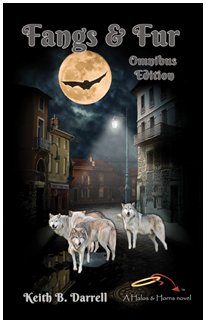
Did you know that May is National Short Story Month? Amber Book Company plans to celebrate by releasing a new volume of my short stories entitled Shards: The Omnibus Edition. Many of you know me from my social commentary posts appearing on my blog, while others are familiar with my young adult science fiction series The Adventures of Mackenzie Mortimer. Still others think of me as a novelist or epic storyteller, pointing to my four-book fantasy series Halos & Horns and my current ongoing fantasy series, Fangs & Fur. There are even some readers who think of me primarily as a nonfiction author because of my internationally top-selling book Issues in Internet Law: Society, Technology, and the Law, my two Web design books, and my Collected Essays of a Reluctant Blogger and More Essays of a Reluctant Blogger books. But the truth is, above all else, I’m a short story writer.

Shards may sound familiar to you. My first short story collection was entitled Randoms. It was lovingly crafted, published in a hardcover edition with a dust jacket. Unfortunately, the printer had tremendous difficulty printing the dust jacket. Every copy rolled off the printing press with a slightly different hue, making each book and instant collectible and the source of much aggravation and vexation. Ultimately, and with great reluctance, we replaced the hardcover edition with a paperback. My second short story collection, Careywood, was a charitable effort published in a limited print run to raise money to restore a historic mansion. Then, in 2011, almost all of my short stories were collected in a giant 450-page paperback entitled Shards. This mammoth collection included the best of Randoms, the stories from the limited edition Careywood, and a host of new short stories, many of which had been shared in public readings but never collected in print. Shards was to stand as my oeuvre: the complete collection of my short story output.

At the time, it was the largest book I had ever written… Ironically composed of the shortest of stories. But with each new edition over the course of 10 years, Issues in Internet Law: Society, Technology, and the Law grew to 680 pages. After I completed the four-book Halos & Horns series, the saga was collected in a single omnibus edition, The Halos & Horns Omnibuswhich clocked in at a whopping 904 pages. Suddenly, the 450-page Shards didn’t seem so big any more. And in the five years since its publication, I had written a few more short stories. I wanted to gather these new short stories into a brand-new collection but the Halos & Horns Omnibus had gone over so well that it was decided to create a short story omnibus.

We began with the original 450-page Shards and reorganized the stories by theme. Then we added 300 pages of new material. That’s right, 750 pages of short stories between two covers. Or 191,523 words if you’re counting. We kept the original front and back cover to Shards and christened it Shards: The Omnibus Edition. The themes in Shards: The Omnibus Edition include man’s inhumanity to man; technology in society run amok; freedom; conformity; slice of life; fear; prejudice; revenge; the inevitability of death; sadness and depression; darkness and light; lust; love; regret; repentance; pity; debauchery and selfishness; hubris; obsession; fusion fiction; Christmas; the quest; the trickster; discovery and wonder; alienation (stranger in a strange land); and farewell.

Admittedly Shards: The Omnibus Edition is a mixed bag. Some of the tales are downright hilarious. Some are frightening. And a few are disturbing. There are stories within this volume you will treasure… and others you may wish you had never read. Good writing isn’t about repeating hackneyed memes; it’s about pushing the envelope and extending the boundaries until the reader finds himself well outside his comfort zone. In Shards: The Omnibus Edition you’ll find stories that make you laugh and make you cry; stories you’ll want to share with your children; and stories so horrifying you’ll banish them to the deepest recesses of your mind. So join me in celebrating national short story month with Shards: The Omnibus Edition.


https://www.amazon.com/Shards-Omnibus-Keith-B-Darrell/dp/1935971239

Friday, February 24, 2017

Are You Prejudiced? The Answer is Yes.

I attended a writers group meeting this week where I was asked to critique a writer’s work. On the second page the writer, a retired white man, had described his protagonist getting into a cab driven by “a black driver.” I asked why he had described the driver as “black”. Was the protagonist a white character in Harlem or some setting where there was a reason to describe the cab driver’s ethnicity or color? He told me there wasn’t. On the next page, the protagonist passed “a brown-skinned woman”. I asked how her skin color was important to the story. He replied it wasn’t, as we never saw this character again. Two paragraphs later, his protagonist encountered “a woman”.

Since she had no adjective preceding her, I had to ask him, “Would I be correct to infer she’s a white woman?” The writer said yes, she was. “But you didn’t put “white woman,” I said. “You simply wrote ‘woman’ because she was a normal person?” He nodded. “And the other characters weren’t normal,” I continued. I could hear the penny drop, the tiny light bulb turning on behind his eyes, as he realized where I was going with this.

“As a white writer, you don’t feel the need to tell your readers your characters are white because you’re assuming your readers are white, and white is the normal skin tone for all characters unless you want to add some ‘color’ to your story. But what you’re saying is white is the default, normal skin tone and race, and anyone else differs from the norm. Imagine how you would feel if you were not a white reader reading the story. You wouldn’t be able to put yourself in the mind of the protagonist because he views you, the reader, and every nonwhite person he encounters throughout the story as ‘other’, ‘not normal’, or ‘different’. Instead of writing something that’s inclusive for your reader, you’ve made it exclusive.”

He asked if I thought anyone would be offended. “I was,” I replied. “And I’m white. This isn’t the 1950s. We live in a multicultural society, and thanks to the Internet as authors our work is read worldwide. The more successful we are, the more our work will be read by people of all races, colors, and cultures.” I explained it’s not just the current population of potential readers, but those who will be reading our books in the decades to follow. About 50 percent of American children under age 10 are nonwhite. Think about that. Half of the potential readership for the young adult book you’re working on today is not white. By the time it’s eventually published, you’ll have excluded half your audience.

Our readership has become more ethnically diverse. In America alone, our society encompasses Hispanics, Asians, and African-Americans of varying skin color. Not only should a Caucasian writer not assume the reader is white, he should not want to give that inference. Unless there’s a good reason to do otherwise, the protagonist should be a chameleon who can take on the characteristics of the reader.

That’s not to say race or color should never play a role in character description. For example, in my Halos & Horns fantasy series I have a character named Asabi whom I have made clear is black. Asabi is an emere: a mythological being who is able to travel between Heaven and Earth. Emeres come from the legends of the Yoruba People in Africa. It’s important that Asabi be black because his origins stem from ancient African legends. It would be insulting in my opinion (or to use the god-awful politically correct term ‘cultural appropriation’) to cast Asabi as anything other than black.

When Asabi had his first romantic relationship, with Cassiopeia, it was important to the plot that I describe her as a white woman. But most of my other characters, unless required by the plot, were never described by the color of their skin. Readers may have assumed the two main characters, Gabriel and Lucifer, were white, but they could just as easily have been black. I left that to the imagination of the reader, and perhaps white and black readers imagined them differently.

The truth is, we’re all prejudiced to some degree simply because of the insular environments in which we were raised. We’ve been brought up to think of the world as pockets of “us” (defined as those who share similarities with us) and “them” (defined by those who differ from us). I know the writer I met this week is not racist; yet he let the vestigial prejudices we all have slip into his writing. For those of us who are writers we must take extra care to make sure our words are not unintentionally exclusive. 

Tuesday, August 23, 2016

How to Write a Book Review

I write a lot of different things – articles, novels, textbooks, short stories – but the one thing I don’t write is book reviews. Why? Because I’m simply not qualified to write a book review. A book review is different from a comment or opinion. Opinion is subjective: I may like or dislike a book, a painting, or a song and not even be able to tell you why. That’s just how I feel about it and others may agree or disagree and none of us is right or wrong. That’s the very definition of art. But craft is different. Craft deals with technique; it is objective, not subjective, and there are standards by which performance can be measured. Was the singer off-key? Is the anatomy in the drawing incorrect? Is the book filled with grammatical errors? Those are objective and quantifiable qualities that can be judged.

However, in rare cases, a creator will put an artistic twist to his craft creating a hybrid that purposely breaks the rules of the art form changing objective craft into subjective art. Tiny Tim and his ukulele would have been a music teacher’s nightmare but his act became a freak success. Pablo Picasso's abstract art style challenged conventional forms of representation, such as perspective, which had been the standard since the Renaissance. Had he been an art student, his teachers would have flunked him. Poet e.e. cummings eschewed capitalization and would cavalierly disregard punctuation when it suited him. Arthur Rimbaud turned the world of poetry on its collective head. Edgar Allan Poe was a central figure of Romanticism, one of America's first short story authors, and regarded as the inventor of the detective fiction genre. Today he is an acclaimed writer read by every school child. Yet, he was never able to earn a decent living from his writing and died in poverty. When art and craft combine, the masses – including critics and reviewers – cannot always recognize the wheat from the chaff.

I don’t have the hubris to claim that ability so I do not choose to be a reviewer. Sure, I’ll offer my opinion on whether I like a song, a painting, or a book. But I don’t want to embarrass myself like my third grade classmate who gave his book report on George Orwell’s Animal Farm summing it up as a rather boring book about farm animals. I first read it when I was seven years old, and then again at age 15. The teenaged me discovered I was reading a completely different novel, a brilliant allegory about the Bolshevik Revolution. I was amazed at how perspective – acquired through maturity and life experience – could change one’s interpretation of an artistic work like a novel. How could I ever review a novel? All I might do is offer my limited perspective of how I viewed it through my life experience and educational background. I had no idea how the same words might resonate differently with someone else who had grown up in a completely different world or who read these same words through a prism of a much broader education then I had received. How much might I have been missing because I didn’t study history, linguistics, or philosophy? How many books might I have judged poorly because I only saw the farm animals and not the philosophical allegories that lay behind them? How many bad reviews might I have written based on my own shortcomings and not on any failings of the writer?

If you just want to comment on a book you've read or leave an opinion, then you should treat it like a third grade book report. Begin by listing the title, the author’s full name (make sure you spell it correctly), the genre, and a brief description or summary of the book, being careful not to give away any spoilers or the ending. You don’t want to spoil your audience’s pleasure in reading this book by ruining it for them. The whole idea of the book report (or review) is to pique your audience’s interest and entice them to read the book and form their own opinions. Conclude with your opinion but always acknowledge, whether you loved it or hated it, that this is merely your own opinion and you recognize other readers may or may not agree with you. Don’t state your opinion as fact. Let your audience come to their own conclusions.

To do that, help the audience find the book. List the ISBN: this is a unique identifying number for every book published. Think of it as a Social Security number for books. With that ISBN, any reader can walk into a bookstore and ask the store to order the book for them if they don’t have it on the shelf. They can search for that ISBN online and find sites that sell the book. Libraries can locate a book using the ISBN. Every edition of a book has its own unique ISBN, so you can immediately refer to an earlier or later printing, an annotated edition, or one using large type.

Tell your readers what formats the book is available in: hardcover, paperback, Kindle, EPUB, Audiobook, etc. Include a picture of the cover with a link to where they can buy copies. (If you’re making money when people click the link as an affiliate, include a disclaimer to reveal that). Add a link to the author’s Website or blog. If you wish, you can also note the publisher, the book’s dimensions, and the page count (or word count if it’s an ebook).

Now if you really want to write a book review, let’s turn to the  elements you should include in your review.
 1. Plot: Is it formulaic and cookie-cutter (”Save the Cat”) or original and creative? Is it hard to follow? Does it make sense? Are there subplots interwoven?
2. Characters: Are they well-defined? Are they 3-dimensional or do they come across as cardboard figures? Do they have individual personalities or could the dialogue between characters be interchangeable? Are these real people with human failings?
3. Dialogue: Does the dialogue fit each character? Does that sound like something a character with that personality and life experience would really say? Is the eight-year-old using a college-level vocabulary? Is the southern sharecropper suddenly extremely knowledgeable about commodities trading? Is the sociopath displaying empathy? Does the dialogue move the story along or is it merely filler, or worse, serving as an info dump? Is there an appropriate balance of dialogue versus exposition?
4. Pacing: Does the story flow smoothly? Are there action scenes to break up the monotony? Are there moments of suspense? Or does the story drag on like one long, boring monotone?

5. Theme: Does the work contain one or more themes? What are they and how are they represented? Is there a message within the story?
6. Symbolism: Is there an underlying meaning  to the author's tale (remember Animal Farm), or in the selection of character names? Often names will have symbolic meanings.
7. Avant-garde: Did the author break any established literature or writing rules or conventions? You may find this annoying and disconcerting because the author is doing something unexpected. The question is, Was this done on purpose, for effect, or because the writer was a novice who didn't know any better? A good writer always knows the rules and then sometimes goes on to break them on purpose. If that’s the case, don’t rush to judgment to hold a writer’s innovation and creativity against him or her. Personally, I’d rather a writer take chances, even if they don’t pan out quite the way the author wished, then to read the same boring cookie-cutter material.

8. Professionalism: Has the writer learned his or her craft? Here I’m talking about technique, not artistic vision. Is the writing style consistent? Does the author use foreshadowing, irony, symbolism, allusion, and metaphor? Does the author establish the setting for each scene or just launch into dialogue? Is the writing concise and crisp, or filled with redundancies and clichés? Does the author use simple declarative sentences, or multiple compound sentences and run-on sentences? Is there a proper balance of exposition and dialogue or does the author rely too heavily on one and not the other? While adverbs and adjectives are essential parts of speech, does the author overuse or misuse them? Is the prose overfilled with unnecessary details? Is the writing filled with exclamation marks? Does the writer properly use “said” for most of his dialogue attribution tags or does he amateurishly substitute anything but (e.g., implored, opined, or my favorite I caught once- ejaculated). Even better, does the writer use a beat of action in lieu of the tag? You can’t giggle, laugh, sigh, or smile spoken words; those are actions. The characters must say words, not smile them. Are there spelling, diction, grammar, or punctuation errors? In other words, was the editor out to lunch, or in the case of self-published novels, was there even an editor?

9. Layout: If it is a self-published book, is the layout professional? Are there unacceptable widows and orphans on the pages? Sufficient margins? Proper leading between lines? Readable type font and size? Proper formatting?
10. The Good, the Bad, and the Ugly: Finally, what do you feel were the strengths of the book? Its weaknesses? Books are like people; none of them is perfect. They all have their strengths and weaknesses; their good points and their bad. The question is, when you add them up, is this person or book someone you would want to befriend or avoid?
11. Accuracy: Is your review factually accurate? The best way to look like an amateur reviewer is to get your facts wrong. I have had reviewers quote things that never appeared in my books; or confuse my main protagonist with someone else in such a way that it showed they hadn’t even read the book. In fact, I had one reviewer admit in the review he had never opened the book before he went on to review it. Another reviewer filmed a video book review: she held up the book to the camera, mispronounced the title, and flipped through the pages, presumably to show that it was, in fact, a real book— That was it. The entire review lasted nine seconds. I even had one reviewer who told me she had intended to leave a five-star review but cut it down to three stars because she thought my depiction of a torture chamber showed I must’ve been a terribly depraved and perverse individual to have dreamed up all those devices; I explained none of what offended her had come from my warped mind but rather from the Catholic Church during the Spanish Inquisition. I’m simply not that creative.

Here’s a final test. Get in touch with your old English teacher. (Never lose contact with your English teachers; they are the most valuable friends you may ever make as a writer). Give her your book review and ask her to grade it. If she gives it an “A”, post that sucker. Anything less, take it back to the drawing board and work on it. Not only will you end up posting a dynamite review, but you’ll learn how it feels to be both the critic and the critiqued. 

Tuesday, May 31, 2016

Celebrate National Short Story Month with Shards: The Omnibus Edition

Did you know that May is National Short Story Month? Amber Book Company plans to celebrate by releasing a new volume of my short stories entitled Shards: The Omnibus Edition. Many of you know me from my social commentary posts appearing on my blog, while others are familiar with my young adult science fiction series The Adventures of Mackenzie Mortimer. Still others think of me as a novelist or epic storyteller, pointing to my four-book fantasy series Halos & Horns and my current ongoing fantasy series, Fangs & Fur. There are even some readers who think of me primarily as a nonfiction author because of my internationally top-selling book Issues in Internet Law: Society, Technology, and the Law, my two Web design books, and my Collected Essays of a Reluctant Blogger. But the truth is, above all else, I’m a short story writer.

Shards may sound familiar to you. My first short story collection was entitled Randoms. It was lovingly crafted, published in a hardcover edition with a dust jacket. Unfortunately, the printer had tremendous difficulty printing the dust jacket. Every copy rolled off the printing press with a slightly different hue, making each book and instant collectible and the source of much aggravation and vexation. Ultimately, and with great reluctance, we replaced the hardcover edition with a paperback. My second short story collection, Careywood, was a charitable effort published in a limited print run to raise money to restore a historic mansion. Then, in 2011, almost all of my short stories were collected in a giant 450-page paperback entitled Shards. This mammoth collection included the best of Randoms, the stories from the limited edition Careywood, and a host of new short stories, many of which had been shared in public readings but never collected in print. Shards was to stand as my oeuvre: the complete collection of my short story output.

At the time, it was the largest book I had ever written… Ironically composed of the shortest of stories. But with each new edition over the course of 10 years, Issues in Internet Law: Society, Technology, and the Law grew to 680 pages. After I completed the four-book Halos & Horns series, the saga was collected in a single omnibus edition, The Halos & Horns Omnibus, which clocked in at a whopping 904 pages. Suddenly, the 450-page Shards didn’t seem so big any more. And in the five years since its publication, I had written a few more short stories. I wanted to gather these new short stories into a brand-new collection but the Halos & Horns Omnibus had gone over so well that it was decided to create a short story omnibus.

We began with the original 450-page Shards and reorganized the stories by theme. Then we added 300 pages of new material. That’s right, 750 pages of short stories between two covers. Or 191,523 words if you’re counting. We kept the original front and back cover to Shards and christened it Shards: The Omnibus Edition. The themes in Shards: The Omnibus Edition include man’s inhumanity to man; technology in society run amok; freedom; conformity; slice of life; fear; prejudice; revenge; the inevitability of death; sadness and depression; darkness and light; lust; love; regret; repentance; pity; debauchery and selfishness; hubris; obsession; fusion fiction; Christmas; the quest; the trickster; discovery and wonder; alienation (stranger in a strange land); and farewell.

Admittedly Shards: The Omnibus Edition is a mixed bag. Some of the tales are downright hilarious. Some are frightening. And a few are disturbing. There are stories within this volume you will treasure… and others you may wish you had never read. Good writing isn’t about repeating hackneyed memes; it’s about pushing the envelope and extending the boundaries until the reader finds himself well outside his comfort zone. In Shards: The Omnibus Edition you’ll find stories that make you laugh and make you cry; stories you’ll want to share with your children; and story so horrifying you’ll banish them to the deepest recesses of your mind. So join me in celebrating national short story month with the publication of Shards: The Omnibus Edition.


Friday, May 13, 2016

21st Century Publishing

It's an incredibly exciting period to be in small press publishing. Print on demand has dramatically reduced the cost of publishing while also eliminating the need for carrying inventory and the burden of returns. The Internet, especially Amazon.com, has redefined the entire distribution paradigm. E-books and other forms of digital distribution have made it possible for small publishers to garner worldwide sales. The Internet has also opened new low-cost, high-reach marketing opportunities, such as author blogging and social media.

The barriers are down and we can reach out to a global market, often on nearly equal footing with the major publishers. I see this constantly at Amber Book Company. One example is our arrangement with VitalSource to offer our books on its Bookshelf® proprietary digital platform; another is our upcoming release of audio books from Audible.com.

These factors have also ushered in a creative Renaissance. Unbound by the chains of the Big Five publishers who acted as gatekeepers and censors of what the reading public might see, authors are now able to publish their work without corporate interests exerting their discretion over what should appear in print. Books can now be tailored to discrete audiences in less popular genres or pertaining to less popular subject matter. Writing that pushes the envelope, no matter how offensive or politically incorrect, may now appear in print. Stories that might otherwise not be told can be read.

It's a time for experimentation. Writers can bravely try new directions and new approaches without fear of the consequences of failure. Some attempts may flop, either creatively or monetarily... Or both. The slush pile of poorly written books will grow exponentially. But beneath the heaps of manure, beautiful flowers will bloom.

Friday, February 19, 2016

Where Do You Get Your Ideas?

On the way home, I stopped at the grocery store – ostensibly to pick up a few items, but in truth, I needed to use their restroom. But once inside the bathroom I found it occupied, so I stepped outside to wait. As I did, another man entered and I knew I was going to have an even longer wait. To take my mind off it, I glanced down at the display items in a bin. I was reading the ingredients on a package of peppermint bark, discreetly doing the “I need to go to the bathroom” jig easily recognized by any second grader, when a woman called me over.

The woman, whose name tag identified her as “Karen,” was in one of those little sampling booths that grocery stores set up to entice customers into trying products they ordinarily wouldn’t look at twice let alone buy. “Would you like some chicken?” She pointed to an array of toothpicks sticking out of tiny slivers of meat. 

“No thank you,” I replied, dancing my indiscreet jig while eyeing the restroom door.

“You look like my husband,” Karen said, almost in an accusatory tone. She stared at me intently.

It was awkward because until the restroom emptied out she had a captive audience. I made a slight grimace. “Um, well, I can assure you, I’m not.” I wasn’t quite sure what to say but I felt that would cover it.

“Oh, I know that. He’s been dead for fifteen years.”

“I’m sorry to hear that.” I shuffled from foot-to-foot, feeling oddly envious of him because at least he didn’t have to pee anymore. I thought perhaps I should express more condolences, maybe throw in a “sorry for your loss,” but before I could say anything, Karen broke out laughing. “It was funny when he died.”

Okay, now condolences seemed awkward. Once more, I was uncertain how to respond. “Really?” I ventured.
She leaned forward. “It’s a funny story. Do you want some chicken?”
Again, I turned down the sample.

“He wore a hairpiece. When he died, I had to call his stylist to go to the funeral parlor and fix it so he’d  look good.” She smiled.

I wasn’t sure if this was the part where I was supposed to laugh, so there was an uncomfortable silence. I was beginning to wish I had stuffed a piece of chicken into my mouth to provide me with an excuse for not replying.

“But you know,” Karen continued, “the head shrinks when you’re dead, and no matter how hard they tried, they couldn’t get that hairpiece to fit.” She laughed, and I realized this must be the punch line. I forced a smile. Karen added, “I still have four of his hairpiece mannequin heads at home. I set them on the counter and he talks to me through them.”

My mind flashed back to an episode of The Dick Van Dyke Show [“Coast to Coast Big Mouth” (1965)] in which Laura (Mary Tyler Moore) accidentally blabs on live TV that her husband’s TV star boss Alan Brady (Carl Reiner) wears a toupee. Laura attempts to apologize to an infuriated Brady, seated behind his desk surrounded by his now-obsolete  hairpiece mannequin heads. Throughout their conversation, Brady pivots to address the heads (“Fellas? There she is. There's the little lady who put you out of business.”).
  
Alan Brady (Carl Reiner) addresses the mannequin heads.

I pictured the woman sitting before four mannequin heads channeling the spirit of her dead husband. What was he saying to her? I wondered. I thought of the Son of Sam killer who had murdered because the voices in his head told him to do so. What might the voice she heard coming from the mannequin heads be telling her to do? I glanced down at the slivers of chicken impaled on toothpicks, thankful I had not sampled them. I began to see the possibilities of a great short story forming. And to think, people believe I’m being facetious when they ask where I get my story ideas from and I reply I pick them up at the grocery store. 

Monday, December 7, 2015

The Colt Principle

I am indebted to my writer friend Colt for introducing me to the literary device I have dubbed the Colt Principle. A writer often finds he has written himself into a corner and desperately needs that can of magic paint to draw a door on the wall from which to escape. Simply put, the Colt Principle says that when you have written a non sequitur into a scene, merely address it and move on.

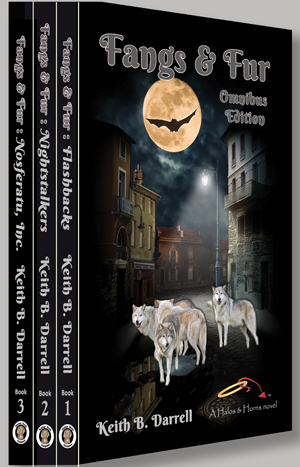
Surely, it couldn’t be that simple, I said. Take my forthcoming novel Fangs & Fur: Flashbacks. I had written a scene where my characters had to be in the waters off the southern coast of Australia. I wanted one character to be attacked by a crocodile. No big deal; after all, Australia is famous for its crocodiles. Think Crocodile Dundee, or Australia’s renowned croc hunter Steve Irwin. But there was one problem: it turns out there are no crocodiles in the waters off the southern coast of Australia. The waters are too cold for them. Oops. The location was set: my characters couldn’t be moved to northern Australia. And I wanted the crocodile scene. What to do? Time to apply the Colt Principle: address the inconsistency and move on.

“What the hell is a croc doing this far south? It’s rare to see them south of Queensland. These waters are too cold for crocodiles.”

“Someone forgot to tell the croc.” Donahue shrugged. “Could be it escaped from the reptile park in Somersby and swam in the wrong direction, or maybe it got loose from one of the tourist attractions. Doesn’t matter now. The poor sheila won’t even have a fair go to make it ashore. That croc will be on her in seconds.”

Someone forgot to tell the croc. Doesn’t matter now. Here’s a plausible explanation, but let’s get back to the action. The Colt Principal strikes again. In my forthcoming book All the Time in the World (The Adventures of Mackenzie Mortimer Book 3), Mac is strip-searched, imprisoned, and issued a prisoner uniform. There’s no way he would have been allowed to keep his time-controlling watch. But of course, he’ll need it to escape. Oops. Time to employ the Colt Principle. Since Mac had received a new watch in the previous book when he had traveled to the future…

“I traveled far into the future and came back with a few improvements.” Mackenzie passed his hand over his wrist and his wristwatch appeared. “Camouflage mode. It does it with holograms. It’s a souped-up version of your pocket watch, Gramps. I’ll explain it once we’re out of here.”

Camouflage mode. Once again, the Colt Principle explains a seeming non sequitur and I’m able to write my way out of a corner. In my forthcoming novel Nightstalkers (Book 2 in the Fangs & Fur series), I introduce a Valkyrie who arrives on a flying horse. The flying horse happens to be the legendary Pegasus. Unfortunately, Pegasus is a product of Greek mythology and Valkyries are from Norse mythology. Oops. Time to resort to the Colt Principle to reconcile this non sequitur.

“Pegasus?” Lupe asked. “The mythical Greek flying horse?”

“He was, until I captured him and made him mine. There is no finer horse in existence, save my Lord Odin’s eight-legged horse Sleipnir. But I’m not here to discuss equine matters.”

The Valkyrie acknowledges that Pegasus’ origins are Greek but explains, in what must remain a fascinating untold back story, that she captured the famous flying steed and “made him mine.” Now let’s move the story along.  Problem solved, thanks to the Colt Principle.

So, if you’re a writer with a deadline approaching and no topic for your blog, simply address it and move on. The Colt Principle… it works every time.

Monday, April 29, 2013

The Italian Interview: Characters in Novels

I've been sidelined by the need for unexpected surgery, so I've chosen to delay the official launch of "The Witches' Cauldron", the fourth book in the Halos & Horns fantasy saga, until next month when I can more actively promote it. Meanwhile (as we say in fiction), you can pre-order the entire four-volume set at a $10 discount by clicking this link. All proceeds will go to my surgeon, whose scalpel slices deeper than any critic's pen, lol.

Since I am somewhat indisposed, I'm going to cheat this week and return to the Italian interview with a bit of cut and paste magic. Enjoy the exchange, below. I'll be back in May hawking "The Witches' Cauldron", so save up your shekels!

Q: Do you purposely write strong female characters?

A:
Wow, that’s a good question. I mean, the way you phrased it. Do I set out to write strong female characters? No, I wouldn't say I have a feminist agenda. Many of my characters, like Angelique Ward and Nyx, are deities or supernaturally powered, so they are innately strong, regardless of their gender. And when I say strong, I don’t mean only physically, although I think physical strength enables one to be more assertive in nonphysical encounters.

A lot of their strength comes from who the character is. Sharon is a cop’s daughter, so she doesn't hesitate to draw a gun and shoot when Pandora stalks her. Chiyoko’s strength comes not only from being a vampire, but from her leadership position, as a Nosferatu, Inc. director, and we get a sense of her almost royal lineage. Valentina is a strong-willed, no-nonsense ex-KGB agent. I think the exchange that exemplified the strong female dynamic was the scene where Lilith, the succubus demoness vied against Angelique for the right to kidnap the infant Alaric. Lilith, who was also Adam’s wife before Eve, says “I have stood up to the first man, to angels, to God, and to a plethora of demons. You will not bar my way, Ancient One.” To which, Angelique replies, “I was ancient when you were created as a mate for Adam. I was ancient long before this planet we stand on was formed. You shall not defy me, Lilith.” This isn't a catfight; it’s two lionesses about to tangle. So no, my women characters aren't in the kitchen baking cookies.

Q: Which of your characters would you like to spend time with?

A: They’re all unique, so I think it would be entertaining to spend time with any of them. Watching the angel, Gabriel, and the demon, Lucifer, bicker would be a treat. Ditto for the changeling, Síofra and the emere, Asabi. The vampire Pandora would be fun, in a space cadet sort of way. If I were a kid, I’d hang with Artemus, the boy vampire, and Emma, the teen witch. A wizard like Merlin or Balthazar would be cool. I’d have a ton of questions for Metatron, the aspect of God, but I doubt he’d give me any clear answers I could understand.

Q: Which characters frighten you?

A: All the demons, of course, are scary. Of the vampires, I’d say Warren was the most vicious. Nathaniel Thornhill, the witch-hunter, is probably one of the most evil, sadistic characters in the series, other than Torquemada. Gen. Asad Hashim was human, but absolutely ruthless and murderous. But I think the characteristics that would frighten me the most are unpredictability combined with an unbalanced psyche, so Morgana le Fay and The Morrigan would fall into that category. They’re scary because they are in large part ruled by their emotions and act impulsively, so they might befriend you one minute and behead you the next.

Drusilla Twitch was one of my favorite scary characters to write. Who else could caress Remick’s face with her long, sharp fingernail and make him stiffen and turn pale? And she has these great one-liners. When Remick says he had nothing to do with the Empusae attack, she replies, “I realize that, Mr. Remick. That is why you are still breathing.” Succinct, if not subtle. When the bogarts tell her they’ve heard tales of her sibling’s animosity toward her, she asks if they’ve also heard tales of her kindness and mercy. When they admit they haven’t, she replies “That’s because there are no such tales” before destroying them. Even Morgana found Drusilla’s gnarled fingers crushing her larynx, her long sharp nails biting into her neck, and droplets of Morgana’s blood trickling down her neck within minutes of meeting her, as Drusilla asked, “Tell me who you are and why I might not wish to kill you.” Succinct, but not subtle.

Q: Would you consider yourself a plot-driven writer or a character-driven writer?

A: One of my writing friends and I have this debate all the time. The correct answer is you need both a strong plot and well-defined characters. My position is characterization that reveals the human condition trumps plot. I like to create unique characters with their own characteristics, foibles, and motivations and then place them together in a setting, sit back and take notes as they interact. Usually, the story writes itself from that point on, and I’m more the stenographer than author. That’s not to say they wander mapless throughout the pages without a plot. I draft a skeletal outline of the novel and each chapter, so I know where we’re headed and how we’ll get there.

Dialogue is extremely important. The characters’ words have to reflect who they are. If either of two characters could have made the statement, then the author hasn’t clearly defined his characters. Síofra is a cynical, ancient changeling, while Kaya is a sheltered, naïve, wide-eyed 10-year-old girl. When they converse, Kaya can’t make a cynical comment or appear too worldly. When they meet someone, Kaya is immediately trusting while Síofra is wary. This is who they are, and who they are determines how they will react in a given scenario. If you meet them in the woods, a bubbly Kaya will invite you home for dinner as Síofra casts an untrusting, wary eye on you.

Q: Have you ever regretted killing off a character?

A: I felt a twinge killing off Maudie, because she was such a likable character and I felt she had potential. But I realized some of that potential could be explored in other ways, such as flashbacks.

When it came to killing off a major character toward the end of the Halos and Horns arc, I did ask myself, Do you really want to kill off a major character? The character could have worked indefinitely as a staple to bring the characters into different plots, but in terms of advancing the story, I thought that character’s potential had been nearly depleted. The death created a new dynamic among some existing characters, and as the saga continues into the next arcs, I think it will lead to a healthier, evolving storyline.

Q: Which locale in Halos and Horns would you like to visit?

A: I’d love to prowl around Absalonis’ curio shop in Copenhagen and see the range of mystic artifacts he has. Actually, I’d love to return to Copenhagen and prowl around the city. (Laughs). I had some memorable times there in my younger days. The Dreamscape – walking through people’s dreams. That could be fun, or terrifying, especially if I landed in my accountant’s dreams – have you seen Donald Duck in Mathamagic Land? Heaven and Hell, of course. And Camelot. As a child, I wanted to be Mark Twain’s Connecticut Yankee in King Arthur’s Court.

Sunday, November 13, 2011

From the Mailbag


I learned a long time ago not to publish email addresses on web pages because there are nasty spammers out there who use things called "scrappers" to collect email addresses off sites to add to their mailing lists. Yet, my clever readers have figured out they can email me through the Amber Book Company website. (Hmm, since the email link is listed in every book and ebook, maybe they're not that clever, after all). Nonetheless, on occasion I receive emailed questions that I feel deserve a wider audience, so from time-to-time I'll peruse the mail sack and post a few here.

Q: I read your posts on Dark Shadows and I was a fan of the series too. Would you ever consider writing a Dark Shadows story or book?

A: I might consider it but it will never happen. Dark Shadows is a licensed property and legally I can't market a Dark Shadows story or book without authorization of the rights holder. I don't write "fan fiction", although I did come up with a premise for a Dark Shadows tale but that's as far as I can go.

I enjoy creating my own characters and universe and working with them, so I hope to create a generation of ardent "Halos & Horns" fans who are as enthusiastic about my fantasy series as I was about Dark Shadows.

Q: Are you an ax-murderer? You must be a depraved person to have created a character like Nathaniel Thornhill in "Paved With Good Intentions".

A: Readers must learn to distinguish an author from his characters. It's fiction; they aren't real people. A fictional character is not a portrayal of the author. If I write about a cannibal, it does not mean I am writing from personal experience of dining on passersby. If I write about a rapist, or a sadist, or a murderer, it does not mean I am one. I do a great deal of research to make my characters appear realistic, but they are not real and they are not self-portraits. It reminds me of soap opera actors who complain fans would accost them at restaurants and lambast them with a harangue about "their" despicable behavior toward another character on the show, not realizing the TV show was make-believe and its characters actors.

Having said that, I do believe Nathaniel Thornhill is the most evil character I've written; and that's saying a lot, considering he is a mortal who appears in a book filled with vampires and demons from Hell. Most of my villains have some redeeming quality that humanizes them, but Thornhill was pure evil.

Q: Do you worry about offending readers?

A: No. I don't set out to offend anyone, but everyone has some topic or concept they find offensive. If a writer censors himself in a futile effort to be nonoffensive, he will produce only pablum.

Pablum is defined as "worthless or oversimplified ideas" and "a soft form of cereal for infants". I write for grownups.

***

Keep sending those emails! I'll need more material for another blog soon.

Tuesday, August 9, 2011

One Day


A friend of mine died, I learned today.

She was not the first friend I’ve lost, but her death was made more meaningful by two facts: I had known her a long time and she was my age.

For 18 years, I saw her every day. We had moved into the same building a few doors from each other and although we became neighbors by chance, we soon became friends by choice. She was a single mother, raising a little boy. Occasionally, I would help him with his math homework, or keep him out of trouble. There was a day in particular, I recall, that earned me his ire. He was about 12 and I caught him playing with fireworks behind our building. I confiscated them and he was irate. How dare I take his firecrackers! He had paid for them with his own money! I had no right… I told him he had 10 toes, 10 fingers, and two eyes, and I was ensuring he would still have them at 6pm when he mother got home from work, at which time I would turn his stash of firecrackers over to her and she could give them back to him, if she wished. I did, and she didn’t.

By today’s standards, some parents would have berated me for interfering with their child, but she didn’t. She thanked me. They moved away a few years ago and I lost touch with them. Until today.

Living near someone for 18 years, you might think you’d know all about them, but you’d be wrong. People are multi-faceted and there are always sides you don’t see. One afternoon, shortly before she moved, I saw her holding a sketchbook. I never had an inkling she could draw. She showed me her sketches and they were good. No, they were outstanding. I told her she could have a second career as a children’s book illustrator. She replied she hoped to do it “one day.”

I knew what that meant. When I was a reporter, most of my colleagues were daytime journalists and nocturnal aspiring authors. They all had a novel in their desk drawer they were working on, and had been working on for years, or decades. They all planned to publish it… “one day”.

I’ve had this discussion with a writer-friend. He believes it’s best for writers to wait until they have matured as writers before becoming published authors. He thinks it’s best to keep those novels locked away for 10, 20, or 30 years because (hopefully) a writer’s skill will improve with time, so one should wait and only publish one’s best work.

After he said that, I read Harlan Ellison’s 50-year retrospective short stories collection and was amazed by Ellison’s growth as a writer over a half century. My friend was right: I would be viewed as a better writer if I wrote for the next 50 years and then published only the last 10 years of my oeuvre. The flaw, of course, being that I would be dead by then, long before my work was published. My writing would end up in a desk drawer, eventually discarded; or like my late friend’s wonderful drawings that the world will never see.

When I tell people I’m a writer, they often respond they’re writing a book, too. They plan to publish it, one day. For me, one day is always today. I may be destined to write the Great American Novel “one day”,  but in the meantime I’ll publish what I write, as I write it; for wouldn’t it be a shame if everything I wrote before then were never seen because I had waited, one day, too long?

Rest In Peace, my friend.
  
No man knows the hour of his death;
Too early or too late?
Premature publication, or might
Posthumous obscurity await?